Category: Blog Post

  • Bullpen Strategy Group Launches Digital Reputation Management Practice

    Helps clients manage brands and issues online, search engine results, Wikipedia, and more

    WASHINGTON, DC – Today, Bullpen Strategy Group (BSG) launched a new Digital Reputation Management practice focused on helping businesses, executives, public policy initiatives, and other clients assess, manage, and strengthen their online profiles, improve Google Search results, create and positively impact Wikipedia pages, among other key services.

    “Bullpen is committed to ensuring we offer the most robust, forward-looking solutions to help our clients solve problems, navigate risk, and grow in the moment,” said BSG CEO Joe Pounder. “That’s why we’re so excited to add Digital Reputation Management as another service for our clients. Using data-driven solutions to help manage and improve our clients’ online positioning is essential in today’s environment – whether it’s Google Search results, Wikipedia, or any other platform. Sound online data management is especially crucial in today’s ChatGPT world. If you aren’t shaping your online data today, you are an AI’s forgettable answer.”

    BSG’s Digital Reputation Management Practice focuses on providing comprehensive, data-driven solutions to a range of challenges facing clients in the digital space, including:

    • Digital Assessment and Audit: Let the experts audit your online profile for an objective view of the current state of play, identify potential trouble spots and opportunities, and get a gameplan for how to improve it over time.
    • Digital Reputation Management – Companies and Issues: Position your brand, issue, or executive’s online reputation so that accurate, up-to-date, and good content rises in search engine results. Solutions often involve understanding and leveraging a range of mediums and outlets, including earned and owned media, business profiles, social media, Wikipedia, video, thought leadership, among others.
    • Digital Crisis Management and Recovery: We work hand-in-hand with clients and their teams to ensure that crisis communications efforts are reflected and synched in the online space, optimizing all available digital resources and platforms to help clients navigate and recover from the crisis.
    • Wikipedia Management: Since it’s often any company or individual’s first search result, Wikipedia is an essential element for online reputation. We help clients create, assess, and manage Wikipedia pages, with the goal of ensuring accurate and fair coverage while adhering to its policies and community guidelines. BSG can also monitor your Wikipedia to ensure you are always aware of what is being added.

    ###

  • BULLPEN BRIEF: New Paper Analyzes the Risk of Social Media Activity to the Financial System

    A new pre-print paper published by academics from universities in the United States, France, and Spain analyzes data from Twitter during this spring’s run on Silicon Valley Bank (SVB) to find “a novel channel of bank run risk that is unique to the social media era” – and that other financial institutions face similar risks going forward. From the paper:

    “In this paper, we present evidence that social media did, indeed, contribute to the run on SVB. More importantly, our analysis suggests that other banks face similar risks. …

    “One core insight is that SVB faced a novel channel of bank run risk that is unique to the social media era. SVB depositors active on social media played a central role in the bank run. These depositors were concentrated and highly networked through the venture capital industry and founder networks on Twitter, amplifying other bank run risks. More importantly, SVB is not the only bank to face this novel risk channel: Open communication by depositors via social media increased the bank run risk for other banks that were ex ante exposed to such discussions in social media.”

    First reported by Axios, the paper helps us further understand how this dynamic constitutes “a new risk to the financial system.”

    The paper examines the impact Twitter users had on what became the largest bank run in history, with $42 billion withdrawn in a single day – $4.2 billion an hour, or more than $1 million per second for ten hours straight.

    The study’s authors attempted to answer whether the collapse was caused by the vast number of individuals Tweeting about the event as it was unfolding, or if this activity just exacerbated the situation. What they found was that a large spike in Tweets by influential members of the startup community – who were also “apparent depositors in SVB” – led to negative bank returns and in turn, stock market losses. While the paper did not have readily available data on deposit outflows, they believe outflows and stock prices are “likely highly correlated.”

    The idea that a large amount of people would be able to coordinate such an event like a bank run seemed too far fetch even a few years ago. As Christoph Schiller, a Finance Professor at Arizona State University and coauthor of this paper said, “that was a difficult thing to do” until recently.

    These increasingly complex dynamics highlight the growing need for companies, investors, and other players to have always-on, professional monitoring systems to alert them in real-time to emerging risks from a range of potential sources, including social media, online organizing, news outlets, etc. At BSG, we have a range of service offerings that do exactly that, helping clients anticipate, monitor, and manage these types of risks in a highly organized, data-driven manner.

    ###

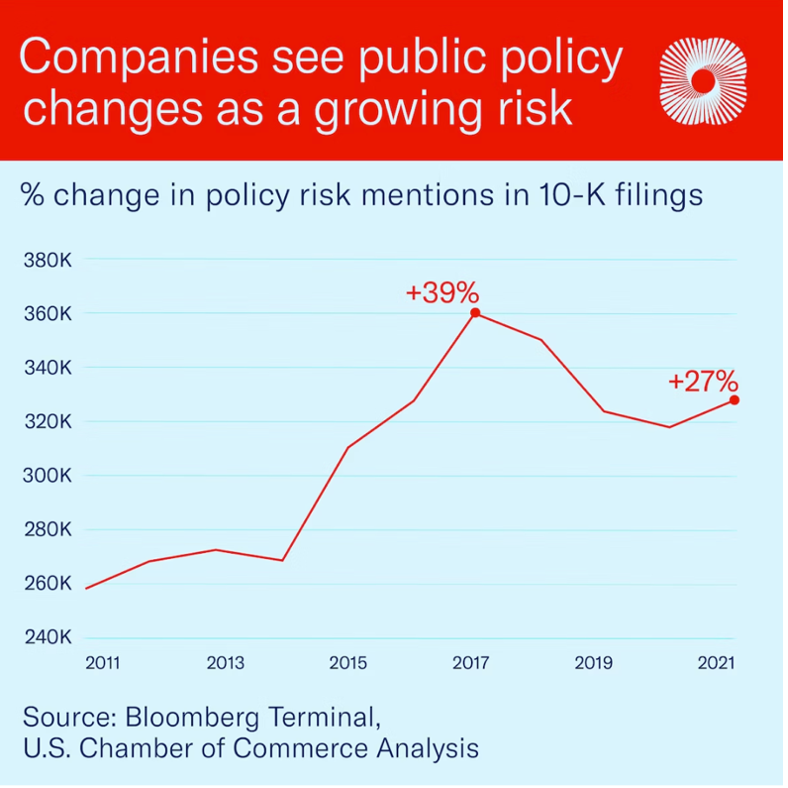
  • BULLPEN BRIEF: New Study: S&P 500 Companies’ Concerns About Public Policy Risks “Have Increased Dramatically Over The Past Decade”

    A new study conducted by the U.S. Chamber of Commerce, and covered by The Wall Street Journal last week, found that S&P 500 companies now report government policies and regulations pose a far greater threat to how corporations conduct their business compared to a decade ago.

    For the study, the Chamber reviewed a decade (2011-2021) of 10-K filings (comprehensive reports filed annually by publicly traded U.S. companies) from companies listed on the S&P 500. The review found that these companies mentioned how government actions pose a potential risk to their business about 325,000 times in 2021 – a 27 percent increase over 2011. As the report reads:

    “According to data in publicly available reports, large publicly traded companies’ concerns about public policy risks—like changes in taxes, regulations, and enforcement—have increased dramatically over the past decade, compared to other risks. This sentiment was measured by tracking terms found in regulatory filings with the Securities and Exchange Commission (SEC).”

    The reason for this sharp increase in public policy risks? The study states that the “increasingly partisan” approach to lawmaking in Washington and “a growing willingness by both parties to pursue aggressive policy changes through regulation” – rather than legislation – are key drivers:

    “The most prominent drivers behind this significant jump in public policy risks are constant shifts in power in Washington, an increasingly partisan approach to lawmaking, and a growing willingness by both parties to pursue aggressive policy changes through regulation rather than congressional legislation.”

    At BSG, we strongly believe the best path for companies in this increasingly challenging environment is to build teams and systems to anticipate, monitor, and manage policy, political, and competitive risk on a day-to-day basis. That’s also the conclusion of the study’s authors:

    “Like other risks, companies must anticipate, monitor, manage, and, when necessary, mitigate risks posed from changes in public policy. This includes closely monitoring public policy developments, engaging with policymakers, and – as we saw for example in response to trade restrictions – adjusting their business operations.”

    ###

  • Bullpen Strategy Group Adds Rob Engstrom As Senior Advisor, Grows Team With New Additions

    WASHINGTON, DCBullpen Strategy Group (BSG) today announced the addition of leading corporate and political advocacy strategist Rob Engstrom as Senior Advisor.

    Most recently, Engstrom served as Chief Political Strategist at the American Bankers Association, and previously spent nearly 20 years in a range of top roles at the U.S. Chamber of Commerce, serving as a senior advisor, senior vice president, and national political director. Leading the Chamber’s national political, grassroots, and election-related activities, Engstrom was the organization’s chief liaison to more than 2,000 state and local chambers of commerce and trade associations. A strategic advisory firm founded in 2019, BSG has grown to nearly 50 team members with offices in Washington, DC, London, and Dallas.

    Bullpen further announced three new staff additions: Carter Reese as Vice President and Jared Beard as Director in the Research practice, and Conor Burke as Associate in the Media Intelligence practice, based in Bullpen’s London office.

    “Rob Engstrom is among the brightest and most respected strategists in Washington, and we’re very excited to add him to the team at Bullpen,” said BSG CEO Joe Pounder. “Rob has spent decades leading on some of the most important policy and public affairs debates facing the U.S. business community – experience that will pay great dividends for Bullpen’s growing set of corporate clients.

    “Further, we continue to build up expertise in our Research and Media Intelligence practice areas with strong additions in Carter, Jared, and Conor.”

    ###

  • Bullpen Strategy Group Expands Partnership, Promotes Seven

    WASHINGTON, DCBullpen Strategy Group (BSG) today announced the expansion of its partnership with the promotion of Pelham Groom from Managing Director to Partner. For the last three years, Groom has led BSG’s media intelligence offering, which has team members from London to DC to the Rocky Mountains and serves a wide range of international corporate clients. A strategic advisory firm founded in 2019, BSG has grown to nearly 50 employees with offices in Washington, DC, London, and Dallas.

    BSG further announced the promotions of Michael Ahrens, Joe Chaudoin, Olivia Perez-Cubas, and Michael Zona to Managing Director, Luke Marchant to Senior Vice President, and Thomas Dee to Director. These are key leaders in BSG’s core practice areas: communications, research, and media intelligence.

    “Pelham has built a best-in-class media intelligence offering over the last several years that delivers high-quality insights and analysis to our clients every day,” said BSG CEO Joe Pounder. “With Pelham’s leadership and our significant investment in technology and data resources, BSG is charting the future of media intelligence, helping our clients navigate today’s complex, fast-paced news environment.”

    “These promotions reflect the deep base of talent and expertise that we continue to build at BSG to help our clients address challenges and meet their objectives. We’re proud to see these leaders continue to grow and evolve as practitioners and professionals at BSG.”

  • Blog Post: How Public Affairs Professionals Should Respond To Uncertainty About Social Media Platforms

    Over the last decade, social media platforms like Twitter and Facebook have become increasingly influential in shaping the debate around politics and public policy. Professionals in the public affairs industry rely on these channels to add their perspectives to the narrative and reach both decision makers and stakeholders.

    Elon Musk’s takeover of Twitter has meant layoffs, lively discussions about changes to the platform, and a spike in interest in migration to platforms like Mastodon. TikTok remains under scrutiny by regulators due to national security and privacy concerns. Governors in at least eight states have banned the platform and lawmakers in Washington have introduced a bill to ban the platform. Facebook continues to shift from news and politics as it eyes the Metaverse. Every platform has varying policies about advertising around public policy issues that change with little rhyme or reason.

    With the future of crucial social media platforms in doubt and their policies towards public affairs and politics, what is the right strategy for the industry as it balances the power of the platforms and the uncertainty of their status?

    How should brands public affairs respond?

    Clearly Articulate Your Goals For Social Media Engagement

    Answering the question “Why are we using social media?” with a specific, credible reason is a prerequisite to being effective. Yes, social media platforms give you a space to publish and distribute content online, but the same can be said of your corporate website. The benefit of Facebook, Twitter, LinkedIn and others are the network effects they provide in reaching significant audiences at scale.

    Merely maintaining a presence on social media may be the extent of your strategy, but if your goals extend beyond that, having clearly articulated outcomes and ways to measure them are essential. This should shift your mindset from something akin to “We have 5,000 followers on Twitter” to “Engagement on Twitter ensures our digital content reaches our key audiences.”

    Go All-In On Owned Audiences

    Your organization’s social media platforms are, in reality, shared with the companies that host them. You have some control over content, but the social media companies determine how widely it is distributed and you cannot take the underlying data about who your followers are with you.

    Effective digital marketing efforts are rooted in the idea of building and nurturing owned audiences. This means investing in your own email lists, web properties, and other channels that you control. These should be the primary sources for distributing news, content, and messages to your stakeholders.

    This does not mean abandoning social media altogether; rather it is a shift in emphasis. Social media should build up your owned audiences. Always have “one foot out of the door” in the event that a social media company goes away or their policies disrupt your strategy.

    Create Your Own Social Space

    It’s easier than ever to maintain your own social media community with platforms like Discourse and Discord. With these applications you can establish forums for members, employees, and other stakeholders to stay up to date on the issues that matter to them.

    By adding a social layer like chats, replies, and direct messages, your internal social platforms can become organizing hubs for additional activity – the network effects seen elsewhere.

    Identify And Partner With Creators And Influencers

    Your target audience is fragmented across multiple social networks and maintaining a presence on all of them is neither effective nor practical. Now, you have to factor in the risk and controversy of a social network as well. So how do you ensure that your perspective is still seen and your content still reaches these audiences?

    Partner with content creators and influencers who already have audiences and reach on social networks to distribute your content and communicate with their followers. They’ve done the hard work of building up a community and have the trust of their fans. Your relationship with content creators and influencers should be an equal partnership because they know what will work and what won’t.

    Tap Into Your Members’ and Employees’ Networks

    Similarly, your members and employees are also active on their own social media platforms and are influential to their networks. But they may not feel confident or safe speaking about your issues. Give them the confidence they need with approved, timely, and relevant messages they can share. Again, trust is a key factor and you are handing some level of control over, but it’s a tradeoff worth making.

    Conclusion

    Public affairs professionals have been struggling with the changes in social media over the last few years. The upheavals with Twitter, Facebook, and TikTok have caused many to re-think their strategies. However, by clearly articulating your goals for social media engagement, going all-in on owned audiences and creating your own social space, you can navigate these changes and continue to be effective in reaching your stakeholders.

    Eric Wilson is a Senior Vice President at Bullpen Strategy Group. He leads the Bullpen Technology Group and advises clients on digital marketing.

  • POLITICO PLAYBOOK

    Tahra Jirari is joining Bullpen Strategy Group as media relations director. She previously was a comms associate at the Niskanen Center.

  • Washington Post: Private Equity Firm Bets On Washington

    By: Theodoric Meyer

    “Private equity is pouring more money into Washington, investing in a group of polling, public relations, lobbying and political consulting firms.

    “Seidler Equity Partners, a private equity firm based in California, has taken a minority stake in a conglomerate of 10 firms. They include Public Opinion Strategies, a leading Republican polling firm; GuidePost Strategies, a bipartisan lobbying firm; and Bullpen Strategy Group, a consulting firm led by the GOP operative Joe Pounder.

    “Seidler’s investment will allow the conglomerate — known as GP3 Partners — to buy more companies in an effort to become a bigger player in Washington, said Darrell Lauterbach, GP3’s president and chief executive. The idea is to serve clients better by offering wider array of services under one umbrella.”

    Read more here.

  • GP3 Announces Partnership with Seidler Equity Partners 

    50 State, 76 Group, Ascent Media, Bullpen Strategy Group, FLS Connect, GuidePost Strategies, IMGE, Public Opinion Strategies, Red Maverick Media, and Strategic Partners & Media, Combine to Form Premier Public Affairs and Strategic Advisory Firm 

    Washington, D.C. (November 10, 2022) – GP3 Partners, LLC today announced its partnership with Seidler Equity Partners. GP3 was formed in 2020, when nine premier political consulting, advertising, and strategic advisory firms merged. GP3 acquired its 10th firm in 2021. GP3 is now one of the largest bipartisan public affairs firms in the country with over 500 employees, a client base of over 1,000, and offices in 15 cities. GP3 is committed to serving its clients with the utmost integrity through state of art technology and a passion for excellence. The minority investment from Seidler provides GP3 with additional resources to continue to align with additional top tier firms and talent in its pursuit to deliver results for its clients. 

    GP3 provides fully integrated services, including strategic consulting, communications, fundraising, grassroots activation, polling, digital marketing, advertising, research, direct mail, and ballot initiative consulting to its diverse and growing client base. GP3 is led by CEO and President Darrell Lauterbach, Executive Vice President of Strategy and Partner, Marie Sanderson (Founding Partner at GuidePost Strategies and Partner at 50 State and IMGE), Marcie Kinzel (Chief Brand Officer & Head of Sales), and CFO John Eberhart. The GP3 Board of Directors is anchored by co-founder Phil Cox, and includes representatives from Seidler and each of the 10 member firms as well as Lauterbach. 

    “Companies clearly want a one stop-shop for all of their public affairs needs and that’s exactly what GP3 is providing,” said Darrell Lauterbach, CEO and President. “We have 10 best-in-class member companies today and have a strong pipeline to acquire more, as we look to double our size in the next few years. We are well positioned to be one of the largest leading public affairs firms in the country.”

    “We understand our clients’ need to understand not only voter motivation, but also consumer behavior, through cross functional services that lead to actionable insights,” said Marie Sanderson, Executive Vice President of Strategy. “Simply put, we are the last firm you’ll need to hire.” 

    “Without a doubt, this is a growing industry and GP3 has brought together the best and brightest resources under one roof,” said Tobin Ryan, Seidler Partner. “We will do our part to support GP3 as it continues on this exciting journey.” 

    About GP3: 

    Born from the need to do things differently for clients. Forged from the most innovative brands in the industry. GP3 brings the best entrepreneurs in the industry under the same roof with a united vision to serve as a one-stop bipartisan shop for clients’ public affairs needs. 

    To learn more about GP3, visit: www.gp3partners.com 

    About Seidler Equity Partners: 

    Seidler and its affiliates have been investing in market-leading companies since 1992. Seidler aligns with business founders and management teams to achieve long-term growth objectives while preserving company culture. Headquartered in Marina del Rey, California, Seidler also has an office in Sydney, Australia and currently has over $3.5 billion of assets under management. 

    For more information about Seidler Equity Partners, visit: www.sepfunds.com

    GP3 Partner Firms: 

    50 State, 76 Group, Ascent Media, Bullpen Strategy Group, FLS Connect, GuidePost Strategies, IMGE, Public Opinion Strategies, Red Maverick Media, and Strategic Partners & Media 

    For Media Inquiries: Marcie Kinzel – marcie@gp3partners.com

  • GP3 Announces Partnership with Seidler Equity Partners

    50 State, 76 Group, Ascent Media, Bullpen Strategy Group, FLS Connect, GuidePost Strategies, IMGE, Public Opinion Strategies, Red Maverick Media, and Strategic Partners & Media, Combine to Form Premier Public Affairs and Strategic Advisory Firm

    Washington, D.C. (November 10, 2022) – GP3 Partners, LLC today announced its partnership with Seidler Equity Partners. GP3 was formed in 2020, when nine premier political consulting, advertising, and strategic advisory firms merged. GP3 acquired its 10th firm in 2021. GP3 is now one of the largest bipartisan public affairs firms in the country with over 500 employees, a client base of over 1,000, and offices in 15 cities. GP3 is committed to serving its clients with the utmost integrity through state of art technology and a passion for excellence. The minority investment from Seidler provides GP3 with additional resources to continue to align with additional top tier firms and talent in its pursuit to deliver results for its clients. 

    GP3 provides fully integrated services, including strategic consulting, communications, fundraising, grassroots activation, polling, digital marketing, advertising, research, direct mail, and ballot initiative consulting to its diverse and growing client base. GP3 is led by CEO and President Darrell Lauterbach, Executive Vice President of Strategy and Partner, Marie Sanderson (Founding Partner at GuidePost Strategies and Partner at 50 State and IMGE), Marcie Kinzel (Chief Brand Officer & Head of Sales), and CFO John Eberhart. The GP3 Board of Directors is anchored by co-founder Phil Cox, and includes representatives from Seidler and each of the 10 member firms as well as Lauterbach. 

    “Companies clearly want a one stop-shop for all of their public affairs needs and that’s exactly what GP3 is providing,” said Darrell Lauterbach, CEO and President. “We have 10 best-in-class member companies today and have a strong pipeline to acquire more, as we look to double our size in the next few years. We are well positioned to be one of the largest leading public affairs firms in the country.”

    “We understand our clients’ need to understand not only voter motivation, but also consumer behavior, through cross functional services that lead to actionable insights,” said Marie Sanderson, Executive Vice President of Strategy. “Simply put, we are the last firm you’ll need to hire.” 

    “Without a doubt, this is a growing industry and GP3 has brought together the best and brightest resources under one roof,” said Tobin Ryan, Seidler Partner. “We will do our part to support GP3 as it continues on this exciting journey.” 

    About GP3: 

    Born from the need to do things differently for clients. Forged from the most innovative brands in the industry. GP3 brings the best entrepreneurs in the industry under the same roof with a united vision to serve as a one-stop bipartisan shop for clients’ public affairs needs. 

    To learn more about GP3, visit: www.gp3partners.com 

    About Seidler Equity Partners: 

    Seidler and its affiliates have been investing in market-leading companies since 1992. Seidler aligns with business founders and management teams to achieve long-term growth objectives while preserving company culture. Headquartered in Marina del Rey, California, Seidler also has an office in Sydney, Australia and currently has over $3.5 billion of assets under management. 

    For more information about Seidler Equity Partners, visit: www.sepfunds.com

    GP3 Partner Firms:

    50 State76 GroupAscent MediaBullpen Strategy GroupFLS ConnectGuidePost StrategiesIMGEPublic Opinion StrategiesRed Maverick Media, and Strategic Partners & Media

    For Media Inquiries: Marcie Kinzel – marcie@gp3partners.com