Category: Bullpen Brief

  • Corporate Communications in an Era of “Global Economic Chaos”

    Words matter, and in today’s challenging, dynamic world, strong and clear communications are key to the success of a campaign, brand, or company.

    Effective communications skills continue to be in high demand, even in an age of AI, according to data compiled by LinkedIn and reported by Axios. According to their data, 9 out of 10 global executives agree that these “soft skills” are more valuable to their organizations than ever before.

    “Human skills, like communication, leadership and teamwork are particularly critical in this moment,” says LinkedIn Learning global head of content strategy, Dan Brodnitz. “With a rise in remote and hybrid work, and now AI, the need for human connection and people skills have become even more important as companies are looking for talent that can step up and create innovative, agile, collaborative teams.”

    Chuck Robbins, chair and CEO of Cisco, and new chair of the Business Roundtable, recently sat down with Axios, with the overarching message that CEOs now believe global economic chaos is the new normal, and that all these situations must be dealt with head-on:

    “There’s a generation of CEOs, with everything going on, that probably would have said, ‘We’re just going to pause everything until things get back to normal,’” Robbins said. But “we think this is normal.”

    At Cisco, Robbins is already planning for the company’s agenda after the presidential election, regardless of who is occupying the White House. Robbins is also keenly aware of the fact that companies are more trusted than government and is looking to leverage that strength for good, adding that most Americans “realize strong companies in the United States do great things for this country.”

    At BSG, our team of communicators spent years honing their skills on top political campaigns, the halls of Congress, and corporate board rooms so they can deliver high-stakes media engagements on behalf of our clients today. We work to develop and execute strategical and tactical communications plans, look for angles to shape the public debate, and turn persuasive messages into winning results.

    Learn more about BSG’s communications practice here.

  • BULLPEN BRIEF: Wikipedia & Digital Reputation Management

    Recently, The Daily Beast reported that Congressman Mike Lawler (R-NY) was temporarily banned from Wikipedia for improperly editing content on his own page. Although the edits he made were factual, it’s a valuable lesson on the risks presented by Wikipedia and the challenge of digital reputation management today.

    The report found that Lawler, using his own username, made some 26 edits to his own Wikipedia page in recent years. The problem was not with the content of his edits, but rather the fact that he was self-editing, which Wikipedia considers a conflict of interest and policy violation:

    Lawler continued to edit his page after receiving a warning, resulting in Wikipedia banning his account. Shortly after the publication of the Daily Beast piece, Wikipedia lifted the ban on Lawler’s account.

    Earlier this year, BSG launched a new Digital Reputation Management practice to help clients manage their brands and issues across the Internet, including help with managing their presence on Wikipedia.

    Wikipedia isn’t like other web publishing platforms. Operated by a vibrant community of volunteer editors – collectively known as Wikipedians – Wikipedia has a novel and specific set of policies, guidelines, and standards that all users must follow, or else potentially lose access to their accounts. At BSG, all work done in this area conforms to these Wikipedia guidelines.

    BSG’s team has deep expertise on these platforms and understands how to effectively manage digital reputation for a range of clients – businesses, high-profile individuals, issues, and more. BSG focuses on providing comprehensive, data-driven solutions to a range of challenges facing clients in online positioning. Contact us to learn more about these offerings.

    ###

  • BULLPEN BRIEF: Tracking Private Jet Travel

    This week, Insider reported “the world’s billionaires … are going to great lengths to hide their private flights.” Despite these efforts, there are several tools that Bullpen’s Research Practice uses to identify and access records about private aircraft, their owners, and flight histories, including SEC filings and databases such as FlightAware and ADS-B Exchange.

    These resources have frequently been used by the media and even anonymous Twitter accounts to track the jet travel of business leaders including Elon Musk, Jeff Bezos, and Bill Gates, as well as political figures such as Donald Trump, John Kerry, and Bernie Sanders.

    Bullpen’s Research Practice has incorporated all of these flight tracking resources into the Research Stack – our major investment in some 200-plus datasets and subscription-based resources that help provide unparalleled insights for our clients. Every day, these tools are utilized in our due diligence and analysis work.

    The following selection of headlines demonstrates the importance of incorporating these valuable insights into communications and public affairs planning:

    Bloomberg: Elon Musk Is So Busy His Private Jet Is Taking 13-Minute Flights

    CNBC: Bill Gates On Why He’ll Carry On Using Private Jets And Campaigning On Climate Change

    Financial Times: US Corporate Jet Spending Jumps As Executives Keep Pandemic-Era Perks

    The Associated Press: Campaign Crunch Time Forces Progressives To Eye Private Jet

    Monitoring private jet travel is only one small component of Bullpen’s research work, but it is a prime example of our commitment to uncovering every detail and mastering all datasets available to help advance our clients’ objectives.

    ###

  • BULLPEN BRIEF: New Paper Analyzes the Risk of Social Media Activity to the Financial System

    A new pre-print paper published by academics from universities in the United States, France, and Spain analyzes data from Twitter during this spring’s run on Silicon Valley Bank (SVB) to find “a novel channel of bank run risk that is unique to the social media era” – and that other financial institutions face similar risks going forward. From the paper:

    “In this paper, we present evidence that social media did, indeed, contribute to the run on SVB. More importantly, our analysis suggests that other banks face similar risks. …

    “One core insight is that SVB faced a novel channel of bank run risk that is unique to the social media era. SVB depositors active on social media played a central role in the bank run. These depositors were concentrated and highly networked through the venture capital industry and founder networks on Twitter, amplifying other bank run risks. More importantly, SVB is not the only bank to face this novel risk channel: Open communication by depositors via social media increased the bank run risk for other banks that were ex ante exposed to such discussions in social media.”

    First reported by Axios, the paper helps us further understand how this dynamic constitutes “a new risk to the financial system.”

    The paper examines the impact Twitter users had on what became the largest bank run in history, with $42 billion withdrawn in a single day – $4.2 billion an hour, or more than $1 million per second for ten hours straight.

    The study’s authors attempted to answer whether the collapse was caused by the vast number of individuals Tweeting about the event as it was unfolding, or if this activity just exacerbated the situation. What they found was that a large spike in Tweets by influential members of the startup community – who were also “apparent depositors in SVB” – led to negative bank returns and in turn, stock market losses. While the paper did not have readily available data on deposit outflows, they believe outflows and stock prices are “likely highly correlated.”

    The idea that a large amount of people would be able to coordinate such an event like a bank run seemed too far fetch even a few years ago. As Christoph Schiller, a Finance Professor at Arizona State University and coauthor of this paper said, “that was a difficult thing to do” until recently.

    These increasingly complex dynamics highlight the growing need for companies, investors, and other players to have always-on, professional monitoring systems to alert them in real-time to emerging risks from a range of potential sources, including social media, online organizing, news outlets, etc. At BSG, we have a range of service offerings that do exactly that, helping clients anticipate, monitor, and manage these types of risks in a highly organized, data-driven manner.

    ###

  • BULLPEN BRIEF: New Study: S&P 500 Companies’ Concerns About Public Policy Risks “Have Increased Dramatically Over The Past Decade”

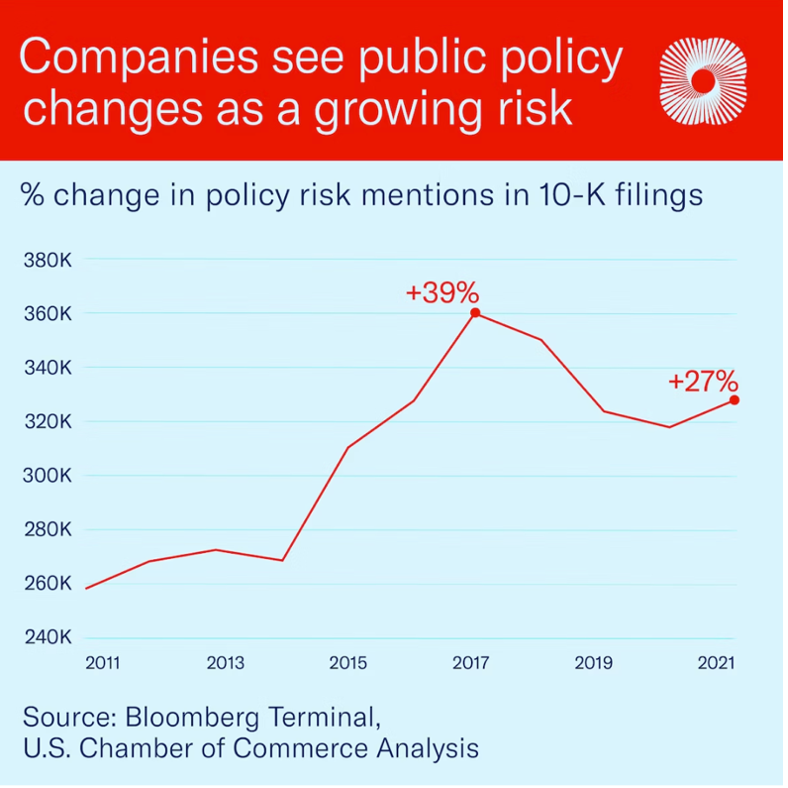
    A new study conducted by the U.S. Chamber of Commerce, and covered by The Wall Street Journal last week, found that S&P 500 companies now report government policies and regulations pose a far greater threat to how corporations conduct their business compared to a decade ago.

    For the study, the Chamber reviewed a decade (2011-2021) of 10-K filings (comprehensive reports filed annually by publicly traded U.S. companies) from companies listed on the S&P 500. The review found that these companies mentioned how government actions pose a potential risk to their business about 325,000 times in 2021 – a 27 percent increase over 2011. As the report reads:

    “According to data in publicly available reports, large publicly traded companies’ concerns about public policy risks—like changes in taxes, regulations, and enforcement—have increased dramatically over the past decade, compared to other risks. This sentiment was measured by tracking terms found in regulatory filings with the Securities and Exchange Commission (SEC).”

    The reason for this sharp increase in public policy risks? The study states that the “increasingly partisan” approach to lawmaking in Washington and “a growing willingness by both parties to pursue aggressive policy changes through regulation” – rather than legislation – are key drivers:

    “The most prominent drivers behind this significant jump in public policy risks are constant shifts in power in Washington, an increasingly partisan approach to lawmaking, and a growing willingness by both parties to pursue aggressive policy changes through regulation rather than congressional legislation.”

    At BSG, we strongly believe the best path for companies in this increasingly challenging environment is to build teams and systems to anticipate, monitor, and manage policy, political, and competitive risk on a day-to-day basis. That’s also the conclusion of the study’s authors:

    “Like other risks, companies must anticipate, monitor, manage, and, when necessary, mitigate risks posed from changes in public policy. This includes closely monitoring public policy developments, engaging with policymakers, and – as we saw for example in response to trade restrictions – adjusting their business operations.”

    ###